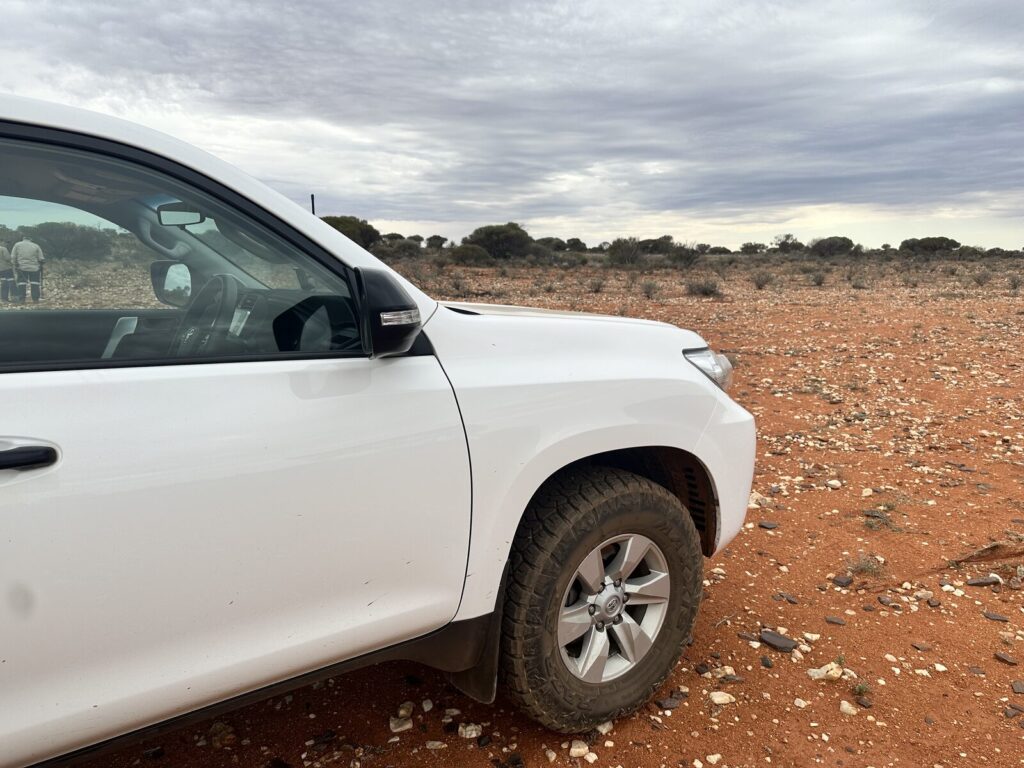
At half past eight this morning, the sentence stopped being true.
The last post ended with me pointing out that I was spending my final night of never having swung a metal detector. That era is over. This morning I drove into the Goldtalk yard at Leonora, met Lisa and Tony, and not long afterwards I was stood on actual goldfields ground wearing a Minelab GPX 6000. Nobody official has stepped in to stop me, so as far as I’m concerned it counts: I am now a prospector. A prospector who has found no gold — but we’ll get to that.
The day opened with formalities: the agreement that lets me detect on Tony and Lisa’s leases. It sounds grand, and it is, and it also took about four minutes over a chat at the yard table. I celebrated by asking how they preferred their flies — medium rare, or rare. “Plucked straight out of the air,” came the answer. Raw, then. I knew I was in the right place.
Before anyone swung anything, we drove out to look at some ground. Not to detect it — to look at it. The first lesson of the day had nothing to do with the detector: it was about looking down. What you want, I now know, is white quartz with ironstone through it — the black, rusty-looking rock. Quartz on its own is just a rock. Quartz with rust through it means something happened here. Twenty-five years finding things underwater, and the first skill of the new trade turns out to be reading dirt.
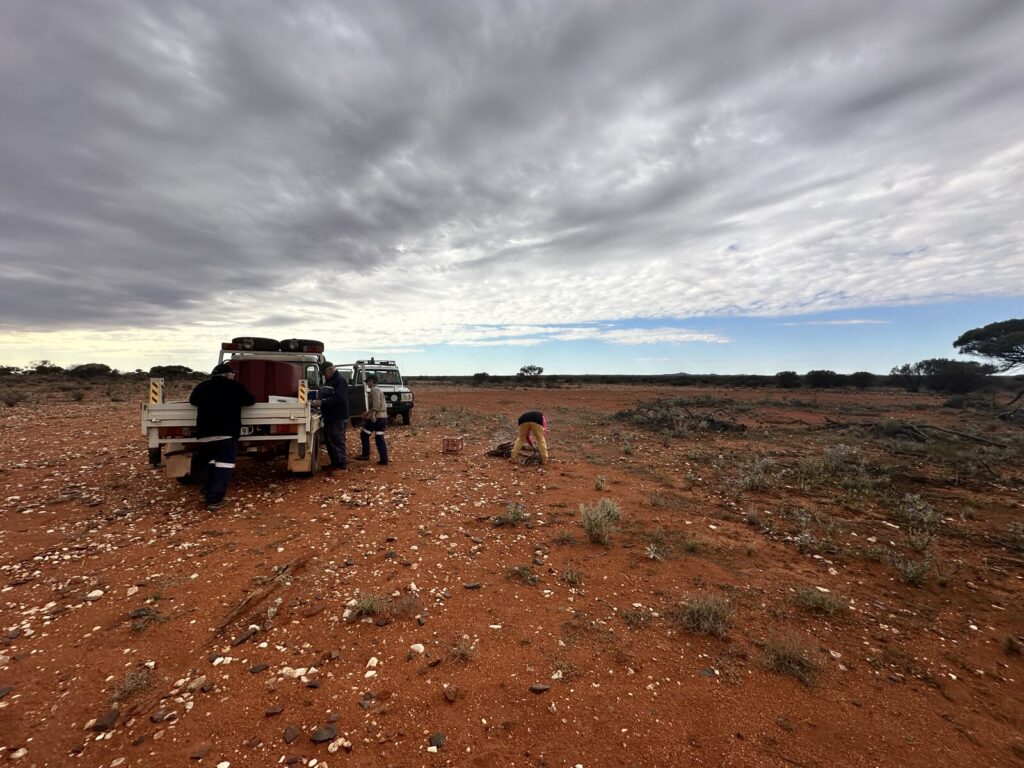
Tony followed with the safety rules, delivered in the tone of a man who didn’t arrive at them by guessing. The car is base. Never let it out of sight. If an hour of detecting turns up nothing, pack up and move. Working a creek line, keep bringing the car along with you. None of that is my wisdom. All of it is now my policy.
Then out to Tony and Lisa’s own tenement, chosen because it’s a safe place to turn a complete beginner loose. Lisa got me going on the 6000 — switch-on, background calibration, ground balance set for difficult ground, sensitivity halfway — and then came the teaching method I most admired all day: they pointed me at a patch of ground they knew was full of rubbish, and told me to go and find some. The point wasn’t treasure. The point was sound — learning what the machine says when there is actually something under the coil.
First discovery: hot rocks. Ordinary-looking stones that shout at the detector. They went off constantly, and the approved technique, gratifyingly, is to kick the rock out of the way and carry on.
The first real target I dug was a piece of tin about the size of a fingernail. I want it on the record that I was delighted. There was a sound; I chased it; there was a thing. The system works. A small nail followed. Then rocks, in quantity.
Promoted to cleaner ground on the other side, I promptly found something that made the detector scream, and then spent a long time digging, sweeping and re-digging while the target turned up in both heaps of dirt but somehow never in the scoop. It turned out to be a piece of fencing wire about fifteen centimetres long. I had been shuffling it around like a shell game. Wire: one. Prospector: nil.
The two other students on the day were both running Gold Monster 2000s — Minelab’s specialist for small, shallow gold. By the end of the day one of them had three little pieces of gold, the other four. I had tin, a nail, and a grievance against fencing wire.
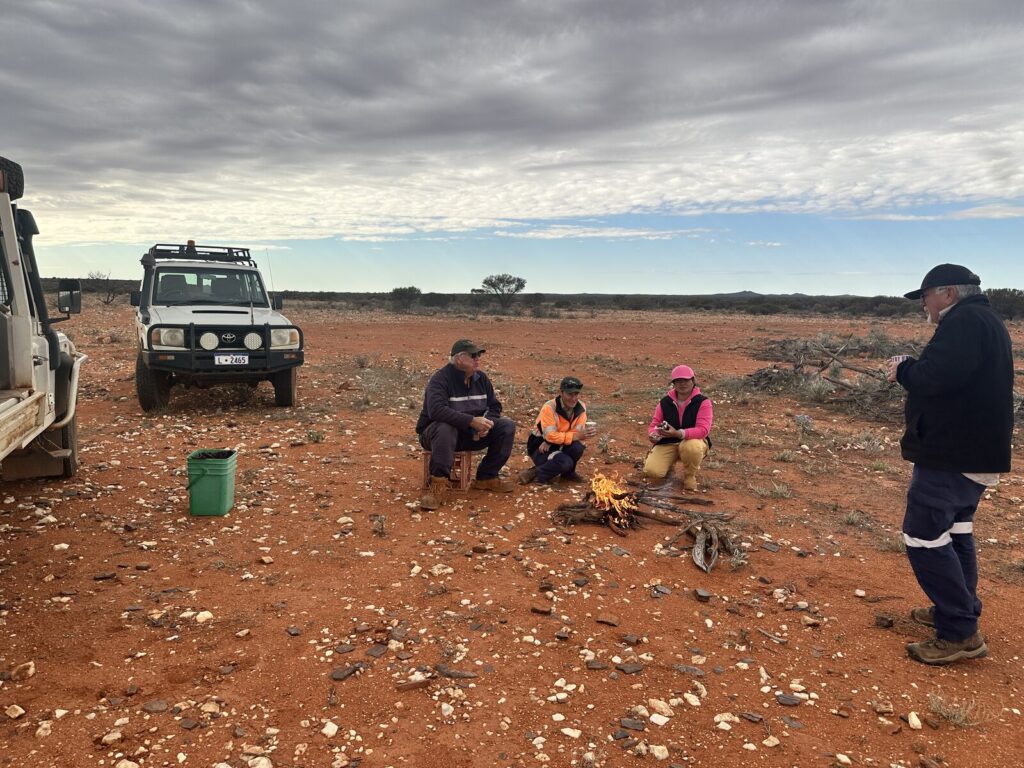
Which brings us to the bottle test. The three pieces of gold went into a small clear bottle, and the bottle went flat on the ground, in plain view, under the coil of my 6000. Nothing. Not a murmur. The machine could not hear three pieces of gold sitting on the surface directly beneath it. There is a proper reason for this — different detectors are built for different gold, and tiny shallow bits are exactly what the Gold Monster is for — but I’m passing that on as received. What I can report first-hand is the feeling of watching your detector ignore actual gold at point-blank range. Educational. And, if I’m honest, a little deflating.
Tomorrow the plan is to go back to the same ground alone and keep training my ears. The complication is the forecast: 28 millimetres of rain due from six o’clock in the morning, and Tony reckons that much water can close these roads for five days. Five days, at this point, would be most of the trip.
So — one full day as a prospector. Finds to date: one piece of tin, one nail, and a loss to a piece of wire. The gold will have to wait for the weather. It has waited a few million years; it can manage a Tuesday.
Pingback: One Piece of Fence Wire - Digging for Legacy