I’ll be honest: AI and I got off to a rocky start. I loved the idea of it — something clever enough to take the boring half of a job off my hands while I got on with the interesting bits. What I usually got back was a confident answer that was confidently wrong. Loved the promise; hated the results.
But I’ve spent a working life in technical environments — years keeping complicated kit running in places people aren’t meant to go — and the engineer’s itch wouldn’t leave me alone. There had to be more to this than I was getting out of it. I just hadn’t worked out how to ask.
In true Rob style
So I decided that learning to prospect, heading bush, fitting out the Prado, building this website and working out everything an old bloke needs to know to find gold… wasn’t quite enough to be going on with. I’d learn how AI actually works at the same time. As I say about skydiving: mind that first step. It’s a big one.
Here’s something I do believe, mind, after years of fixing things for a living — if you can find a real problem and build something that takes the pain out of it, you’re onto a winner.
Finding the pain
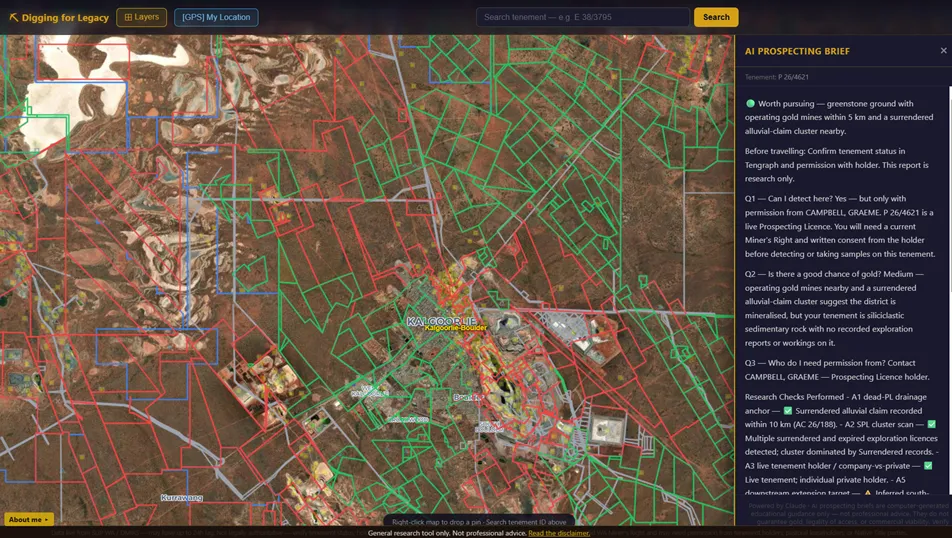
Finding the pain wasn’t hard. It’s called Tengraph — the Western Australian government’s online map of mining tenements. It is a goldmine of information, in every sense of the word, and getting at it can feel like reading a phone book through a letterbox. Everything you could want is in there; it’s just not the friendliest thing to navigate.
Now, one thing AI is genuinely good at is reading. Interrogating websites, pulling down documents, sifting through more government data than any sane person would volunteer for. So off I went to see whether I could get it to gather all that scattered information from the official sources and lay it out in one place. Turns out, yes — that part was doable. That was the encouraging bit.
“So where’s the gold, then?”
What I’d love to tell you next is that the AI then pointed at the map and said, “Dig there, Rob — nugget the size of your fist.” It doesn’t work like that. And this is the part most people get wrong about AI, so it’s worth slowing down for.
If you ask an AI where the gold is, it will usually give you an answer. A clear one. A confident one. And it’ll be complete rubbish. Not because it’s lying to you, but because of how these things were built: trained to always produce a plausible-sounding answer, whether or not there’s anything real behind it. The trade calls it a “hallucination” — the machine making something up that sounds right but isn’t. A confident guess in a nice suit.
The newer thinking — and the whole trick to making AI genuinely useful — is getting it to do the opposite of what it was trained to do. To stop. To check. To go and look at the real, verified records before it opens its mouth, and to be willing to say “I don’t know” when that’s the honest answer. Less of a know-it-all; more of a careful assistant that shows its working.
Teaching it to stop and think
So that’s what I set about building. I did a fair bit of training, watched an unreasonable number of YouTube videos from prospectors who actually know what they’re doing, and tried to teach the AI a thing or two along the way — which, I’ll admit, taught me a good deal more than it taught the machine.
The result is the Prospector built into the map. When it gives you a brief on a patch of ground, it isn’t plucking a lucky spot out of the air. It checks what it tells you against the verified government records — the same official data, just without the letterbox — and it’s built to ground every answer in something real rather than guess. No invented nugget locations. No promises it can’t keep.
A place to start
What it will do is give a beginner — namely me — an honest, legal place to begin: what the ground is, who holds it, what the rules are, and a sensible spot to start swinging a detector. Whether there’s any gold under it is between me, the dirt, and a great deal of luck.
Which feels about right. I went looking for a tool that would do the hard part for me, and I’ve ended up with one that’s honest about the hard part still being mine to do. For an old engineer who’s all ideas and no gear, that’ll do nicely for a first step.