Post 01 — The Why
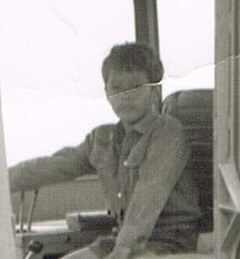
When I was a young man, I used to chase girls.
I had to enjoy the thrill of the chase, because I never really caught any.
Now I’m much too old to chase girls, so I’m going after gold. Same thrill. Probably the same success rate. But I’m in the game.
That’s the short version. Here’s the longer one.
My name is Rob. I grew up in a small village in Lincolnshire, left at seventeen for three years in Kingston Upon Hull to get an engineering qualification, and arrived in Scarborough afterwards with a plan that extended approximately as far as finding somewhere to live.
A friend there wanted to join the Territorial Army. He asked if I’d come along for moral support while he signed up. I stood outside the interview room. The captain conducting the interview looked out and said my friend’s friend could come in and take a seat — so long as he joined up.
I assumed he was joking.
I sat down. Didn’t pay much attention to the interview happening next to me. At the end of it, the captain told my friend his medical was on Monday. Then he turned to me and said my medical was on Tuesday, and training started next month.
Walking out, I turned to my friend and said: did I just join the army?
He said: yes, I think you did.
I lasted a couple of months. The highlight was a two-week exercise on Salisbury Plain, where our group of four was assigned to play the enemy — paratroopers who had landed behind lines, tasked with locating whoever was sheltering in a wooded area at night.
Our corporal had other ideas. Instead of reconnaissance, he decided we should attack the wood. There were four of us. With blank rounds. Against approximately ninety people inside, trying to sleep.
When he said open fire, my first thought was: they are not going to be happy about this.
They were not.
Rather than play fair and return fire, ninety soldiers decided to get out of their sleeping bags and run directly at us, shouting things I cannot print here.
Being young and reasonably fit, I ran. Fast. Very fast. Fast enough that I was several metres ahead of everyone else when I ran straight into a barbed wire fence at full speed, catapulted over it, spun in the air, and landed sitting upright on the other side.
From somewhere behind me in the dark, the corporal said: thank you for finding the fence.
The four of us spent the next several hours hiding in a bush while ninety furious soldiers looked for us, got bored, and went back to bed.
I left the Territorial Army shortly afterwards. I feel this was the right decision for everyone involved.
After Salisbury Plain I headed to London. Field service engineer for a mainframe computer manufacturer. A proper job. A flat. A girlfriend. A life that looked, from the outside, entirely reasonable.
Then one week happened.
Sunday: the girlfriend left. Monday: I lost the job. Tuesday: my dad died. By the end of the week, the landlord turned out to have not been paying the mortgage, and the house was being repossessed.
Four things. One week. I moved back to my mum’s.
The area had high unemployment and was largely populated by people who had gone there to retire. I was neither retired nor employed. I sat with the newspaper one day and found an advert in the back pages.
ROV Pilots Wanted.
I had absolutely no idea what an ROV was. But pilot sounded interesting. So I applied.
Three weeks later I was standing on a ship in the North Sea in the pouring rain and a full gale, holding a yellow tether connected to a bright yellow underwater vehicle somewhere beneath the surface, on my second ever shift, wondering what exactly I had done.
The supervisor, from inside the warm control room, had positioned the ROV directly next to one of the ship’s thrusters. The thrusters had opinions about this. Strong ones. They were pulling the ROV — and the tether — and me — steadily toward the side of the ship. Before I went for an unplanned swim in the North Sea, I managed to wrap the tether around a scaffold tube welded to the railings and hold on.
The supervisor came out of the control room and took charge. Loosely.
He ordered four riggers to pull the ROV in by hand. Four grown men could not move it. I found this genuinely comforting.
Then he had what he appeared to believe was a stroke of genius. He attached an air winch line to the tether, under what he was certain was the handrail. He stood at the rail, signalling the winch driver with great authority.
I stood watching, in a gale, in the rain, having narrowly escaped death once already that shift, thinking: I survived a barbed wire fence on Salisbury Plain for this.
The winch strained. Then — bang.
It was not a handrail. It was the gangway gate.
It launched itself clean out of its retainers, hit the supervisor squarely under the chin, and sent him airborne. The yellow tether snapped and disappeared overboard. I watched the supervisor land. I saw the blood. I looked out at the North Sea.
And I thought: yes. This is the life for me.
I stayed offshore for twenty-five years.
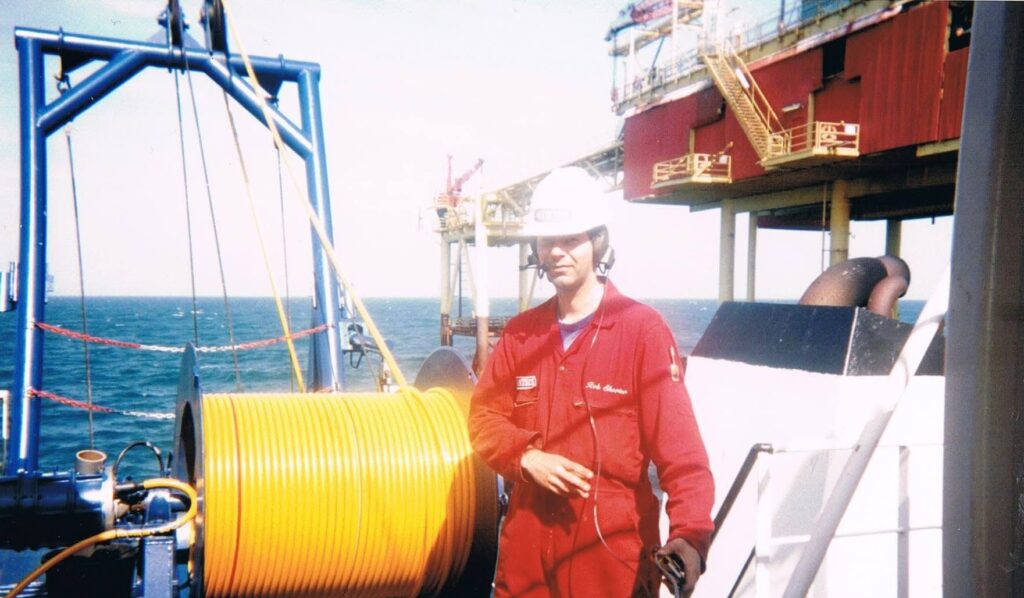
That’s a long time to spend on ships. I worked my way up to ROV Supervisor, which is a job that sounds considerably more glamorous than it is when a gangway gate is trying to remove your chin.
Eventually I ended up in New Zealand full time. The reason, if I’m honest, was that it looked nice. I retrained in SCADA and controls engineering — largely self-taught, which is either impressive or alarming depending on whether you’re the one operating the plant — and built a second career from scratch.
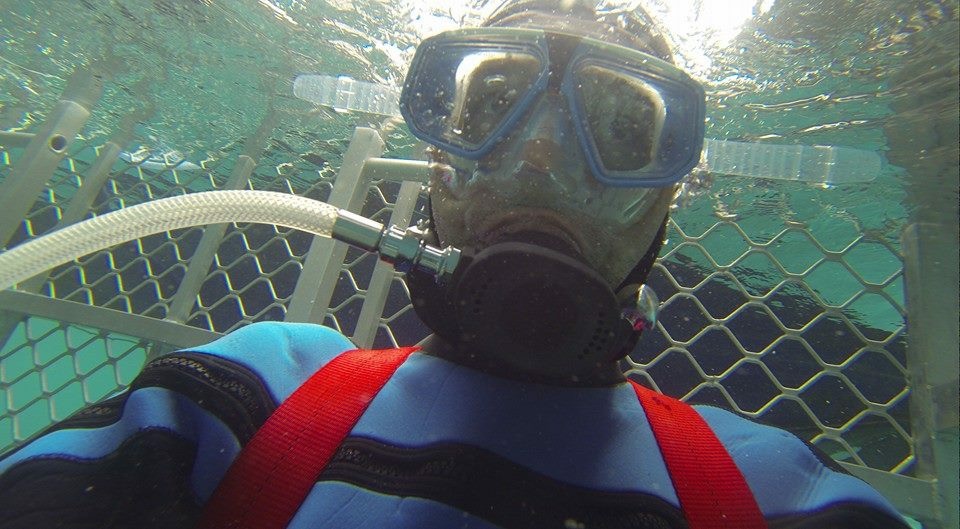
Along the way there were other adventures. Cage diving with great whites at Bluff. Learning to skydive at fifty-one. Racing motorcycles — badly. The ambulance was involved on at least one occasion. A friend said I needed a special fuel cap on my dirt bike because the thing spent more time upside down than right-way up. I rode a Honda Fireblade up a snow-covered volcanic mountain while tourists with snow chains looked on in genuine confusion.
Thrills. Spills. Bills.
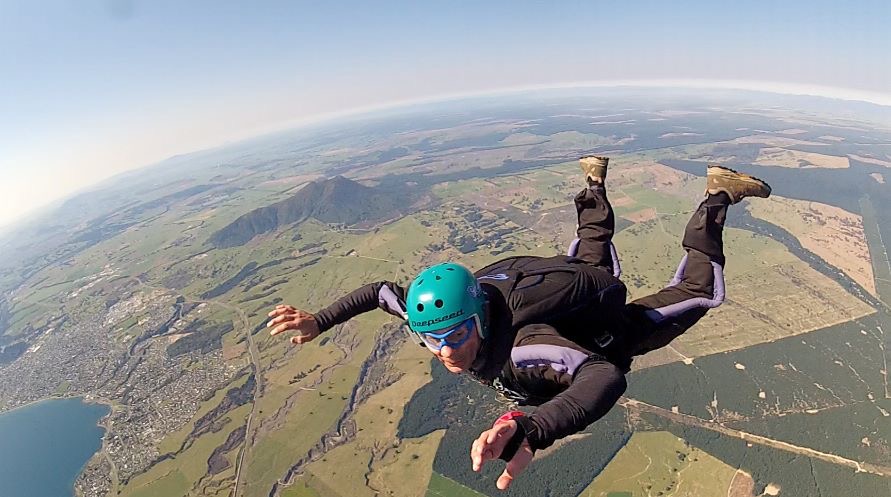
Bluff, New Zealand. Inside the cage. By choice.
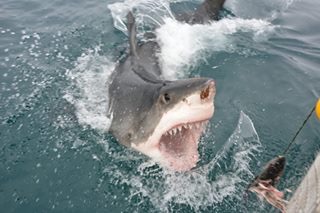
The other side of the cage. Also by choice, technically.
Then Amanda arrived. We looked at what we had, where we were, and what we wanted next. Australia felt like it offered something New Zealand didn’t. Within three weeks of arriving in Perth I’d been offered several jobs, none of which I had a clue about.
Why start being sure about things now.
I’m approaching retirement. I have a white Toyota Prado, a 120 amp-hour lithium battery I wired myself, a fridge slide I built myself, and a Zoleo satellite communicator in case it all goes badly wrong in a remote location. I have a partner called Amanda who has the patience of a saint and the good sense not to ask too many questions.
And I have two grandchildren in New Zealand who I miss every single day.
I won’t put their names here — this is the internet and they didn’t ask to be on it. But they are the real reason this website exists. Not the gold. Not the adventure. Not even the thrill of the chase, though I’ll be honest, that’s a factor.
I want to leave them something. Not money. Not stuff. Something they can read when they’re older and understand who their grandfather was. What he thought was worth getting out of bed for.
What drove him to enlist accidentally in the army, nearly drown in the North Sea, fly face-first into a barbed wire fence, dive with sharks, fall out of a perfectly good aeroplane, and eventually point a very expensive metal detector at two billion year old rock in the Western Australian outback.
I want them to know who on earth that was.
That’s what this is. Digging for Legacy.
One man. One detector. One very patient partner called Amanda. And somewhere out there in the red dirt —
Maybe something shiny.
— Rob
Pingback: Prospecting Map App: Building It With AI
Such a great idea Rob to document the highlights of your life thus far, sad the GK’s are not close enough to visit daily or weekly for that matter, I hope and pray this will change for you in the future. All the best that you will find the “golden girls”